Monday, October 18, 2021

Join us for a Virtual Conference - Topics in Audiology - Audiological Supports in Education and Early Developme

Click the above image to register for our conference!

About this event

Practical technology tips, connectivity considerations, and ways pediatric/clinical audiologists can support children and educators.

Keynote Speaker: Krista Yuskow, Au.D., R. AuD

Beyond Amplification

Clinical audiologists are not typically able to see the extensive effort of their fittings or mappings at work beyond the clinic walls. While a clinician’s window to their patients’ daily listening environments is limited to subjective feedback, educational audiologists have the unique opportunity of observing and addressing barriers to auditory access beyond hearing aids and cochlear implants. This session will explore some of those barriers and provide considerations and related strategies.

Other Presenters & Topics will Include:

Sarah Kiefer, MA Ed., Deaf Education Coordinator, Center for Deaf and Hard of Hearing Education

  • Indiana update on current educational trends for children who are deaf and hard of hearing.

Bethany Colson M.A., M.S.D.E., CCC-SLP, Executive Director, Center for Deaf and Hard of Hearing Education

  • Indiana Deaf Education and Assessments of Language (IDEAL) - What audiologists and other providers need to know.

Allison Soll, Au.D, CCC-A, Pediatric Account Manager, Oticon Inc.

Evan Claytor, Au.D., Account Manager Children's Hospitals & Schools, Phonak US

  • Assistive listening technology options for the classroom, featuring presentations by Oticon and Phonak.
  • Practical technology tips and connectivity considerations in the classroom and ways pediatric and clinical audiologists can support children and educators.

Cindy Lawrence, MA-CCC-A, Early Intervention Coordinator, Center for Deaf and Hard of Hearing Education

  • Indiana early intervention for children who are deaf and hard of hearing - Benefits of audiologists collaborating with other EI providers.

Suzanne Foley, M.A., Au.D., CCC-A Director, Indiana EHDI Program

  • Indiana EHDI’s Best Practice Diagnostic Follow-up Guidelines.


We hope to see you there!


Wednesday, October 13, 2021

Teachers' DEN: Language Rich Environments

 Language Rich Environments …            
The other LRE to consider for your DHH students

The Least Restrictive Environment (LRE) is most likely the term that you are familiar with as it is one of the vital components developed in a child’s IEP. The least restrictive environment ensures your student has the necessary access in and out of their classrooms. However, have you, or your case conference committee, considered if your Deaf and Hard of Hearing student’s least restrictive environment is also the one providing language rich opportunities?

Check the below infographic to see if these situations are being covered in their classroom(s). If they’re not already in place, we encourage you to reach out to your school team to facilitate these opportunities. That way you can make their Least Restrictive Environment is truly a Language Rich Environment. 

Infographic

Please link and share this information with your colleagues!


Monday, October 4, 2021

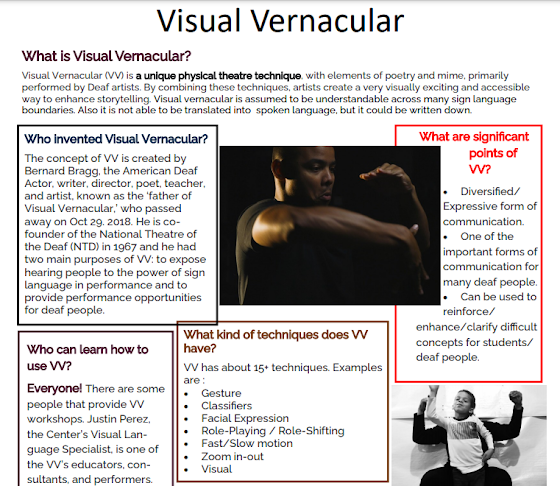
Language and Literacy Corner: Visual Vernacular

Check out these great examples!
“TIR”, which means “truck” in Polish, is a short story about how small decisions, fractions of a second, can affect people’s lives.

Deaf Fest Visual Vernacular: The Body

Here are some more examples of Visual Vernacular videos (Use your eyes):Visual Vernacular—The Center for Public TelevisionVisual Vernacular Stories: Meet Catbot!The Performance!

Monday, September 27, 2021

TEACHERS' DEN - The Unexpected Benefits of Virtual Learning


The Unexpected Benefits of Virtual Learning

The COVID-19 pandemic has certainly shifted the approach to education. While there have been numerous downsides that students have experienced over the last year, there have been a great deal of benefits that have emerged. While not all of these benefits apply to every virtual education setting, opportunities for enhanced accessibility, inclusivity and overall universal design for learning continue to be on the rise.

  • Virtual education means no face coverings to create visual or auditory barriers to access.
  • While using a device, students have improved visual access to whoever is speaking—teachers or students. Students can see all peers on screen and view speaking peers in a larger window.
  • Video conference platforms have embedded additional accessibility features by offering auto-subtitles and captioning. Teachers have increased the usage of closed captioning on videos.
  • Students can directly connect hearing assistive technology to devices and have enhanced access to teachers and students without having to pass around a microphone to each speaker.
  • Students have an increased ability to control background noise and visual environment. Students are afforded flexible seating options in remote settings.
  • Students are quickly and easily able to ask their teachers questions or for clarification.
  • Students have been able to remotely participate and receive services from non-local programs that specialize in deaf education.
  • Teacher notes and recorded sessions are digitally available to pause, rewind and view/review multiple times to aid in comprehension. Assignments are posted and available virtually.
  • There has been an increase in access to qualified interpreters since location is not a barrier.  Students are able to see an interpreter and the educational content in the same visual field. There is also an ease in securing substitute interpreters in the virtual space.
  • There are increased opportunities for direct instruction from the teacher of the deaf and hard of hearing—professionals can virtually attend meetings without having to plan for transition time between classrooms or buildings.
  • Parent participation in IEP meetings has increased as parents are able to attend on lunch breaks rather than having to take time off of work to travel and attend.
  • The use of technology and advanced features sharpens digital, technical, and typing skills.
  • Teachers have reported that interactive virtual lessons have increased focus and self-discipline.

Monday, September 20, 2021

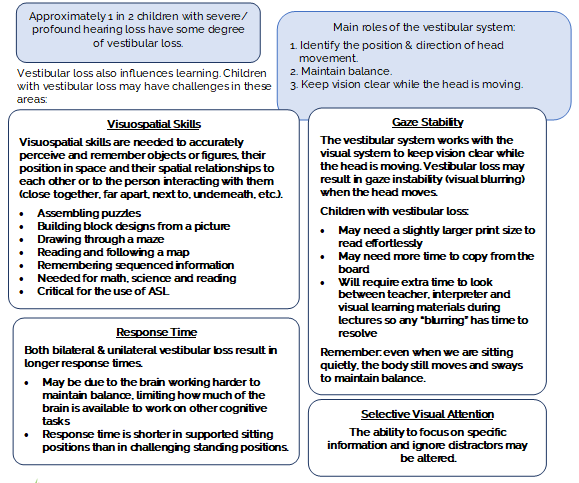
Tacklin' Assessment - Vestibular Loss and Learning


 Vestibular Loss and Learning


Sources: 

1.    Lacroix E, Edwards MG, De Volder A, et al. Neuropsychological profiles of children with vestibular loss. Journal of vestibular research: equilibrium & orientation. 2020;30(1):25-33.

2.       Braswell J, Rine RM. Evidence that vestibular hypofunction affects reading acuity in children. International journal of pediatric otorhinolaryngology. 2006;70(11):1957-65.


Monday, September 13, 2021

Brain Builders Corner - Early Intervention

Navigating Transitions

One of the areas of service we provide through our network of specialized early intervention providers is oversight for families during the transition process—from Part C (First Steps) to Part B (school). Yet our experience with these transitions did not prepare us for the unexpected transitions throughout the COVID-19 pandemic. State mandates, including quarantine and social distancing, 

meant transitioning to virtual services overnight in order to provide continuity of services for some of our most vulnerable citizens: infants & toddlers. Now, 16 months after implementing teleservices, we have been able to clearly see benefits of virtual services, ensuring more equitable services statewide. 

We are now offering a hybrid approach to services within our CDHHE network. This model consists of one in-person visit per three virtual visits. Feedback from providers and families about how best to integrate virtual services long-term has helped shape this new model. For more information about the coaching model adopted in Indiana and resources check out the Family Guided Routines Based Intervention website.

Among all of these changes, we continue to support families as their children transition out of First Steps on to the next part of their journey in school. We updated our family transition resource: Navigating Transitions for Deaf and Hard of Hearing Children in Indiana to include links to our IDEAL documents. This navigating transition resource identifies how to utilize the IDEAL initiative, among other valuable resources as families go through the transition from First Steps family-centered services to school-based    services at age three.

We can think of this transition from early intervention to school services as part of a relay race in a track meet. The relay starts when hearing is found to be a potential barrier through the universal newborn hearing screening and identification process. The baton is carried through the First Steps system until the child reaches age three. In relay races, there is a section on the track when the next runner is poised to receive the baton and the first runner has to carefully and precisely pass it on without dropping it to the next runner. This is similar to transition—when the child’s services are passed from early intervention system to the school system. It is important that care is taken to not drop the baton—that both systems are poised and ready for this exchange. The center is supporting families in the process to ensure they are knowledgeable and confident as this transition occurs.


Language and Literacy Corner: The Art of Narrating your Day