Monday, February 21, 2022

Family & Community


Navigating Special Education Today

Join us for this special four-part series that will help you understand your child's educational rights and work effectively with school personnel to maximize your child's educational opportunities.

In this webinar series, you will learn:

  • What to expect in the special education process
  • How an Individual Education Plan (IEP) is created
  • What procedural safeguards are available to you
  • Skills for effective advocacy
  • How to resolve disputes 

This is a great workshop for anyone that is new to special education and a great refresher for others.


Dates: Thursdays, February 3, 10, 17 & 24
Time: 7:00 - 9:00 pm (Eastern)
Presenters: Cheri Dowling & Kelly Meissner
Platform: Zoom
Cost: $75*

*ASDC members, save $25 on registration. 
Email cheri@deafchildren.org to receive your discount code.
Not a member yet? Join here for $35

Our IDEAL Parent Document now includes Spanish language milestones.


Monday, February 14, 2022

Tacklin' Assessment - Social Emotional Development


Nurturing the Mind

Children who are deaf or hard of hearing may have significant delays in acquiring social emotional skills, including Theory of Mind, due to a lack of adequate access to language Check out these Early Social-Emotional Development skills and tips!


"Deaf children can become socially and emotionally competent if given the same opportunities as hearing children to develop self awareness, independent thinking, and good problem-solving skills over the course of their development." -  Calderon & Greenberg, 2003 

Resources for social-emotional skill development

Tuesday, February 8, 2022

Job Posting: Audiologist


Join our team!

The Indiana Department of Health is currently seeking an Audiologist within the Center for Deaf and Hard of Hearing Education. This position will act as a point of contact for the provision of technical assistance and support throughout the state.
This employee will provide direct services to families as well as collaborate with professionals throughout the state, assisting the center with the mission: To promote positive outcomes for all deaf and hard of hearing children through information, services and education. The Center is seeking professionals with experience providing pediatric audiological services, working with families, and collaborating with other professionals – sharing resources and expertise.

Audiologist

This position provides audiological services to children ages birth through school exit. The audiologist in this position will develop and provide resources to families and professionals as a primary point of contact for provision of technical assistance and support throughout the state. Travel is required, including travel with other staff members through the Center’s mobile unit- to ensure continuity of care, enhance likelihood of successful outcomes for children/students who are deaf and hard of hearing.
Job Posting: https://workforindiana.in.gov/job-invite/269883/

For further information about this position:
Contact Michelle Wagner-Escobar, Audiology Coordinator

Center for Deaf and Hard of Hearing Education
Indiana Department of Health
Mailing Address: 2 N. Meridian Indianapolis, IN 46204
(317) 232-7438 Phone
(317) 520-3301VP

Job Posting: Early Intervention - Educational Consultant


Join our team!

The Indiana Department of Health is currently seeking an Educational Consultant within the Center for Deaf and Hard of Hearing Education. This position will act as Early Intervention Specialist for the CDHHE Network serving deaf and hard of hearing children and their families in Indiana's First Steps early intervention program.

This employee will provide direct services to families through the First Steps early intervention system as well as collaborate with professionals throughout the state, assisting the center with the mission: to promote positive outcomes for all deaf and hard of hearing children through information, services and education.  The Center is seeking professionals with experience providing early intervention services, working with deaf/hard of hearing infants and children, as well as families, and collaborating with other professionals - sharing recourses and expertise. 

Early Intervention Specialist

This position provides early intervention services to children ages birth to three, facilitating high-quality service delivery through a coaching model in the family's natural environment. Travel is required to meet this need. Teleintervention will also be utilized. This position collaborates with the Early Intervention staff to plan and implement professional development opportunities and resources for our CDHHE network contractors. This position works to build understanding and capacity of provider throughout the state and represent our Center in collaboration with First Steps, Local Planning and Coordinating Council (LPCC) representatives, Early Hearing Detection and Intervention (EDHI) Parent Guides, and others.


For further information about this position:
Contact Cindy Lawrence, Early Intervention Coordinator

Center for Deaf and Hard of Hearing Education
Indiana Department of Health
Mailing Address: 2 N. Meridian Indianapolis, IN 46204
(317) 232-0899 Phone
(317) 520-3301VP

Monday, February 7, 2022

Language and Literacy Corner


Starting with a good foundation

Literacy development support starts with a good foundation. An educational interpreter in the state of Indiana should have at least a high school diploma or equivalent and hold and maintain either Registry of Interpreters for the Deaf (RID) certification or an Educational Interpreter Performance Assessment (EIPA) rating of 3.5 or higher. In addition, the interpreter should have access to and a good understanding of the IEP goals and objectives of the students for whom they interpret.

If a student is unable to process information presented in a signed and/or spoken language, it is highly likely that they will be unable to read it. The educational interpreter is often the only professional in the child’s educational setting that can identify breakdowns or gaps in a child’s signed language development. When these gaps/breakdowns are identified, the educational interpreter should be working in tandem with the classroom teacher, speech language pathologist, and teacher of the deaf

TIPS

The Laurent Clerc National Deaf Education Center provides these tips that an educational interpreter can employ to support reading aloud in the classroom:
  • Use appropriate pausing and allow the students to take in the book visually so they can see the English text and illustrations on the pages. 
  • Highlight key vocabulary or phrases within the story visually on the blackboard, overhead, or laptop connected to a projector or television. 
  • Give the student a copy of the book for reference during the read-aloud. 
  • For read-aloud time with student participation, have the interpreter confirm where the group is within the text to assure the student who is deaf or hard of hearing is in the appropriate place. 
Educational interpreters have the benefit of close and frequent contact with students. Leveraging their time and expertise can be a powerful tool to attaining a major goal of education – language and literacy proficiency. 

Additional Resources:

Monday, January 31, 2022

Staff Spotlight

Welcome to the team Dr. Kayla!

We welcomed Kayla Whitaker to our staff in November as the newest addition to the Audiology team at the Center. She comes to us from Connecticut Children’s Medical Center. Kayla has roots in the Midwest. She is originally from Dayton, Ohio and received her Bachelors of Science and her Doctor of Audiology degrees from the University of Cincinnati. 

Kayla has experience serving on or working alongside the Early Hearing Detection and Intervention taskforces in multiple states, including Connecticut, Ohio, and Tennessee. She strives to provide excellent audiological services and to guide families through the process of hearing aid selection and the daily use of amplification through open communication, teamwork, and maintaining a positive environment for all children and their families. Kayla is an expert at working with children of all abilities. 

Fun Facts!

  • Kayla and her husband have three cats at home: Benny, Beau, and Jeff 
  • Kayla loves to cook and bake
  • Kayla enjoys making pottery and painting with watercolors


Monday, January 24, 2022

Sound Advice on Listening Breaks


Listening is tiring!

Dr. Krista Yushow, an expert in educational audiology, shared considerations for helping deaf and hard of hearing children combat listening fatigue in the classroom at the second annual Topics in Pediatric Audiology Conference, hosted by the Center in Nov. 2021.

“When you are hard of hearing you
struggle to hear; when you struggle to hear you get tired;
when you get tired you get frustrated; when
you get frustrated you get bored;
when you get bored you quit”  - Pichora-Fuller (2003)

What is listening fatigue?

In order to understand speech, deaf and hard of hearing children must use more brain power for listening than other children. Their brain has to work harder to process the same information. This causes an increase in stress and eventually, fatigue!

Hearing Aids

Hearing aids improve listening and speech comprehension in quiet listening environments, which helps
decrease listening fatigue.
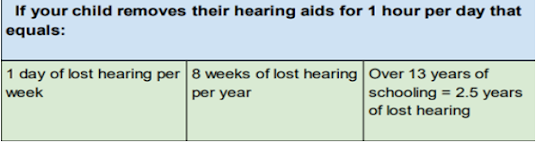
  • Encourage all day use of hearing aids, no matter the severity of hearing loss. Severity of hearing loss does not determine educational impact!
  •  Pick bright and fun colors to promote acceptance and pride in their identity.
    • Ask your audiologist for fun stickers to put on hearing aids
    • Check out hearing aid accessories, earrings, and charms on Etsy!

Personal Remote Microphone Systems 

  • Hearing aids provide excellent benefit when your child is close to the speaker. As distance and background noise increase, additional technology is needed to hear and understand speech.
  •  Direct microphones transmit the speaker’s voice directly to hearing aids, which help reduce the negative effects of distance and background noise.
  • Use in noisy environments like grocery stores or restaurants, or when your child is in a stroller in order to provide the best access to speech in all environments!