Showing posts with label ASL. Show all posts

Monday, July 11, 2022

TACKLIN' Assessment - ASL Skills Checklist


You may be familiar with the Visual Communication and Sign Language Checklist - a standardized,     comprehensive checklist used to assist in tracking young children’s sign language development from birth to age 5. Did you know that staff from the Center for the Deaf and Hard of Hearing Education developed an alternate checklist to assist in tracking children’s sign language development? This new measure is the ASL Skills Checklist. It is based on Gallaudet’s standardized visual communication and sign language curriculum, Indiana curriculum, Indiana Deaf Education and Assessments of Language (IDEAL) milestones, and BEYOND IDEAL ASL Language milestones. You’re probably very curious about what the difference is between VCSL and our beta ASL skills checklist. The ASL Skills Checklist included all ages from birth to high school! (Deaf applause)

This ASL skills checklist is intended for use in the state of Indiana. It can be administered by fluent users of American Sign Language. Hearing staff are encouraged to partner with deaf adults who are fluent in ASL. Let’s keep our Indiana deaf children’s language development on track.


Who can administer this ASL skills checklist?   

· Deaf mentors/school age mentors

· Early interventionists who are fluent in ASL 

· Professionals on an evaluation team who are  fluent ASL users

· Teachers of the deaf who are fluent in ASL 

· Visual language specialists/ASL specialists


Monday, February 7, 2022

Language and Literacy Corner


Starting with a good foundation

Literacy development support starts with a good foundation. An educational interpreter in the state of Indiana should have at least a high school diploma or equivalent and hold and maintain either Registry of Interpreters for the Deaf (RID) certification or an Educational Interpreter Performance Assessment (EIPA) rating of 3.5 or higher. In addition, the interpreter should have access to and a good understanding of the IEP goals and objectives of the students for whom they interpret.

If a student is unable to process information presented in a signed and/or spoken language, it is highly likely that they will be unable to read it. The educational interpreter is often the only professional in the child’s educational setting that can identify breakdowns or gaps in a child’s signed language development. When these gaps/breakdowns are identified, the educational interpreter should be working in tandem with the classroom teacher, speech language pathologist, and teacher of the deaf

TIPS

The Laurent Clerc National Deaf Education Center provides these tips that an educational interpreter can employ to support reading aloud in the classroom:
  • Use appropriate pausing and allow the students to take in the book visually so they can see the English text and illustrations on the pages. 
  • Highlight key vocabulary or phrases within the story visually on the blackboard, overhead, or laptop connected to a projector or television. 
  • Give the student a copy of the book for reference during the read-aloud. 
  • For read-aloud time with student participation, have the interpreter confirm where the group is within the text to assure the student who is deaf or hard of hearing is in the appropriate place. 
Educational interpreters have the benefit of close and frequent contact with students. Leveraging their time and expertise can be a powerful tool to attaining a major goal of education – language and literacy proficiency. 

Additional Resources:

Monday, October 4, 2021

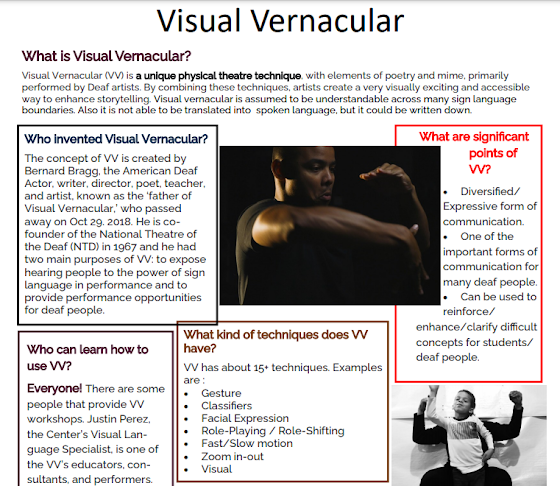
Language and Literacy Corner: Visual Vernacular

Check out these great examples!
“TIR”, which means “truck” in Polish, is a short story about how small decisions, fractions of a second, can affect people’s lives.

Deaf Fest Visual Vernacular: The Body

Here are some more examples of Visual Vernacular videos (Use your eyes):Visual Vernacular—The Center for Public TelevisionVisual Vernacular Stories: Meet Catbot!The Performance!